Why Electricity Has to Balance Across a Grid
Why electricity has to balance across a grid: see how supply and demand stay aligned, what frequency signals and how operators respond as conditions change.
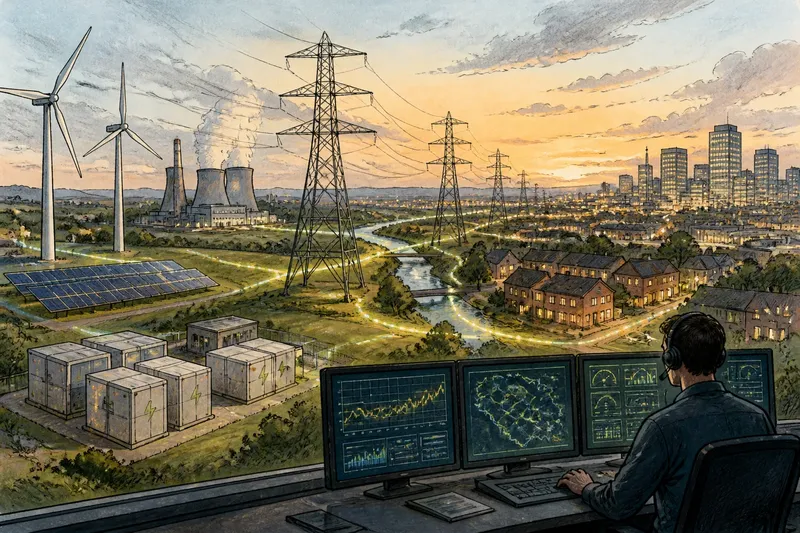
Electricity has to balance across a grid because connected generators and users share an electrical system that responds continuously to changes in supply and demand. Switch on a kettle and the demand changes; a generator, storage resource or another part of the network must help meet it as it happens. Balance is not a setting applied once and left alone. It is an ongoing condition maintained through changing flows and rapid adjustments.
What does grid balance mean?
Grid balance means that, across the connected system, electrical supply is kept closely aligned with electrical demand. The balance is not necessarily a perfect match at every individual location: electricity travels through a network, and the grid’s operators manage the system as a whole while respecting its physical limits.
Demand includes the electricity being used by homes, businesses, public services and industry, as well as energy needed to move power through the network. Supply comes from generators and, where available, storage discharging into the grid. Imports and exports across connections with neighbouring systems can also affect the balance.
The word “balance” can sound like a static equation, but the real system is moving. A cloud can reduce output from solar panels; wind can strengthen or ease; a large industrial load can change; and a generator or line can become unavailable. Operators respond to the combined effect, not just to one isolated change.
Why does balance matter?
A grid runs at a shared alternating-current frequency. In Britain, that frequency is nominally 50 hertz. If supply and demand drift apart, the system’s frequency tends to move away from its target. A sustained imbalance can make equipment harder to operate reliably and can trigger protective measures that disconnect equipment to limit damage or wider disruption.
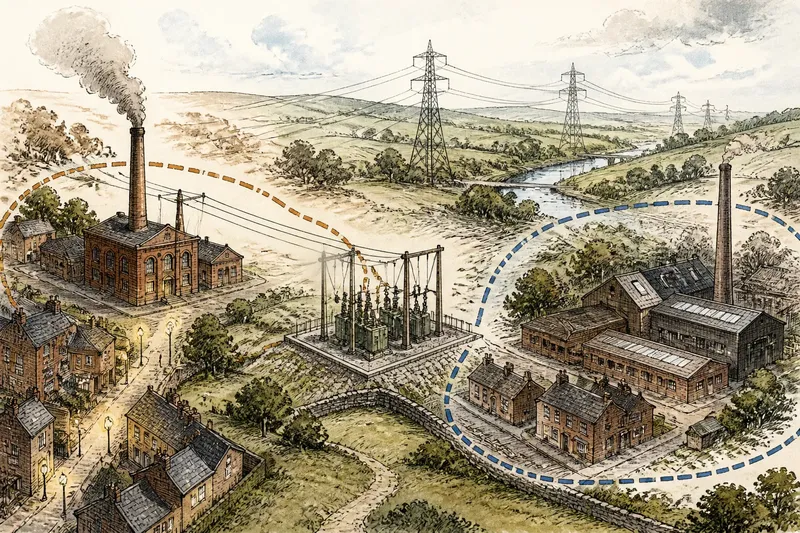
Frequency is an important signal, but it is not the only one. The network also has to keep voltage within workable bounds and ensure electricity can travel along available lines without overloading them. A system can have enough generation in aggregate and still face a local constraint: power may be available, but the route to a particular area may be limited.
That is why “there is enough electricity” and “electricity can reach the right place at the right time” are related but different questions. Operators need to maintain the overall balance while also managing how power moves through the network.
How does frequency show imbalance?
When demand rises faster than supply, the frequency tends to fall. When supply exceeds demand, it tends to rise. This response is a physical feature of the connected system, not a meter that directly counts every appliance. Frequency gives operators and automated controls a fast indication that the system needs adjustment.
Some generators and other resources can respond automatically to frequency changes. These responses help arrest a developing deviation, buying time for further adjustments. The exact behaviour depends on the equipment, its settings and the services it has been arranged to provide.
Frequency should not be mistaken for a complete picture of grid health. Operators also monitor forecasts, generator availability, network constraints and other operating conditions. A normal frequency reading at one moment does not mean that no balancing work is needed; it means the system is currently being kept within its operating range.
Who keeps supply aligned?
Grid operators coordinate balancing, while generators, storage operators and other providers supply resources that can change output or consumption. The precise arrangements vary by system. In Britain, the electricity system operator coordinates balancing actions across the transmission system and works with participants that can provide flexibility.
Some changes happen automatically. Other actions are scheduled or instructed as conditions develop. A generator may increase or reduce its output; a storage unit may discharge or charge; or a flexible user may alter electricity consumption under an agreed arrangement. Imports and exports may also be adjusted where connections and agreements permit.
Balancing is not the same as simply asking every generator to produce more. If a transmission line is constrained, increasing output on the wrong side of that limit may not solve the problem. Operators may need to adjust generation in different places, manage flows, or use other available resources to keep both supply and the network within acceptable conditions.
Why is balancing continuous?
Electricity demand changes throughout the day as people wake, cook, work, travel and use equipment. Weather-dependent generation also varies with wind, cloud and other conditions. Forecasts help operators prepare, but they cannot remove every difference between what was expected and what actually happens.
Balancing therefore has several time horizons. Ahead of real time, operators and market participants plan around expected demand, available generators and likely network conditions. As the operating period approaches, updated forecasts and schedules refine that picture. During real-time operation, automatic responses and operator actions address changes that remain.
After an adjustment, the situation may shift again. A resource can reach a limit, demand can move, or another part of the network can become unavailable. The system must keep adapting rather than treating an earlier correction as permanent.
What happens when conditions change?
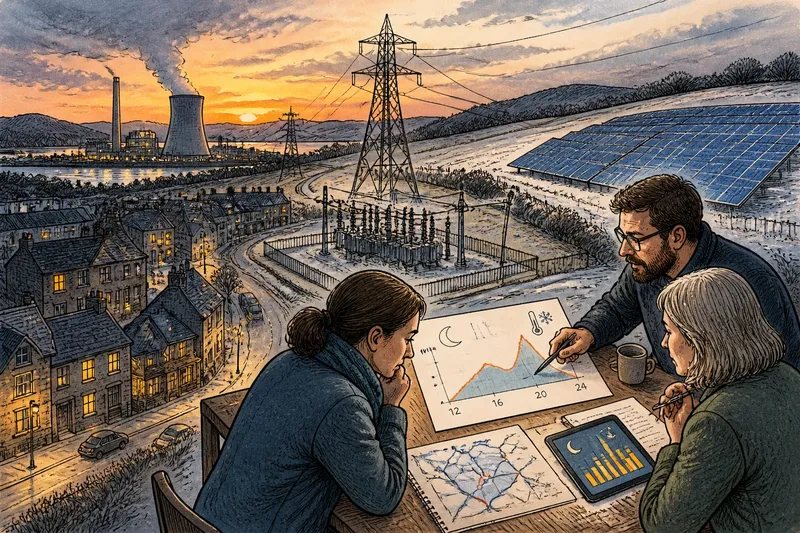
Suppose, in an invented scenario, a gust of wind raises output from a wind farm while a bank of cloud reduces output from solar panels during a period of rising evening demand. The starting point is a forecast that expected steadier renewable output and a gentler demand increase. Operators could use updated forecasts, available flexible generation and other contracted resources to respond; the observable aim would be to keep frequency and network flows within operating limits as the mix changes.
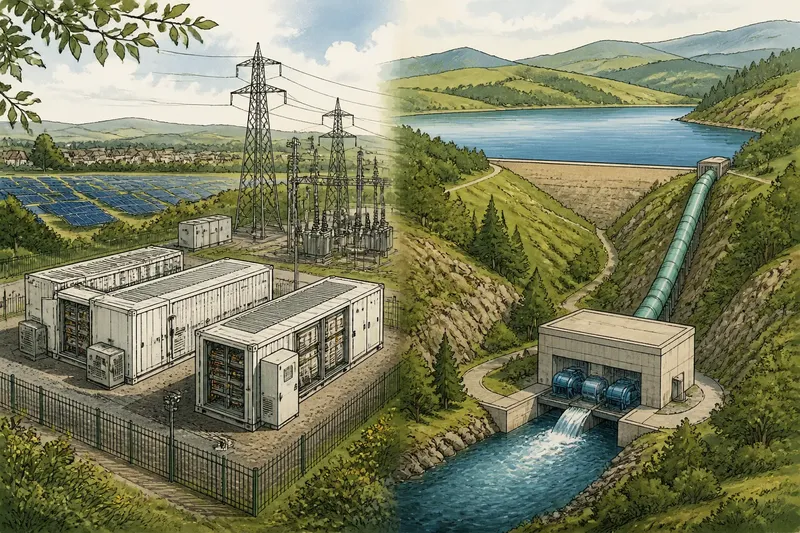
The scenario illustrates why a grid needs more than a single reserve of “extra power”. The useful response depends on the location, timing and type of change. A resource that can act quickly may help with a sudden shift, while other resources may be better suited to a longer adjustment. Network capacity can determine whether a resource is useful to the part of the system that needs support.
When the available responses are insufficient, operators have additional measures to protect the system, which can include restricting some generation or, in severe circumstances, reducing demand. Such measures are not routine substitutes for balancing; they are among the actions used to manage conditions when normal resources cannot resolve a constraint or shortage.
What can ordinary users change?
Most people do not balance the grid directly. Operators coordinate the system, and the equipment connected to it has to meet relevant technical requirements. Some households and businesses may take part indirectly through flexible tariffs, managed charging or services arranged by an energy provider. These options depend on the contract, equipment and local arrangements.
If you have an electric vehicle, heat pump or other flexible load, shifting use may help align consumption with periods when your tariff or supplier signals that electricity is more suitable to use. That can be a useful personal choice, but it is not the same as operating the grid. Nor should anyone switch off essential equipment or alter electrical installations to try to manage system balance.
For most users, the effort of trying to infer grid conditions from a single headline or frequency display is not worthwhile. A signal needs context: local network constraints, system forecasts and available resources all matter. Use the information your supplier provides for decisions about your own flexible demand.
Does balance mean constant generation?
No. Balance does not require every generator to run at an unchanging output. It requires the combined supply and demand to remain aligned as individual sources and uses vary. Flexible generation, storage, interconnection and demand response can all contribute, but they do so in different ways and over different periods.
Nor does balancing mean that electricity is stored in the wires as a reserve. The grid is primarily a delivery network: electricity is generated or discharged from storage as it is needed, then routed through connected equipment to users. Storage can shift energy between times, but its role is distinct from the continuing coordination of the grid as a whole.
For readers asking why electricity has to balance across a grid, the practical answer is that the network is shared and changes moment by moment. Frequency helps reveal an imbalance; operators and responsive resources help correct it; and transmission limits shape which responses will work. That continuous coordination is what lets a changing mix of generators and users function as one connected system.