Batteries or Pumped Storage: Two Ways to Hold Energy
Batteries or pumped storage store electricity in different forms. See how each holds energy, releases it and fits particular places and grid needs.
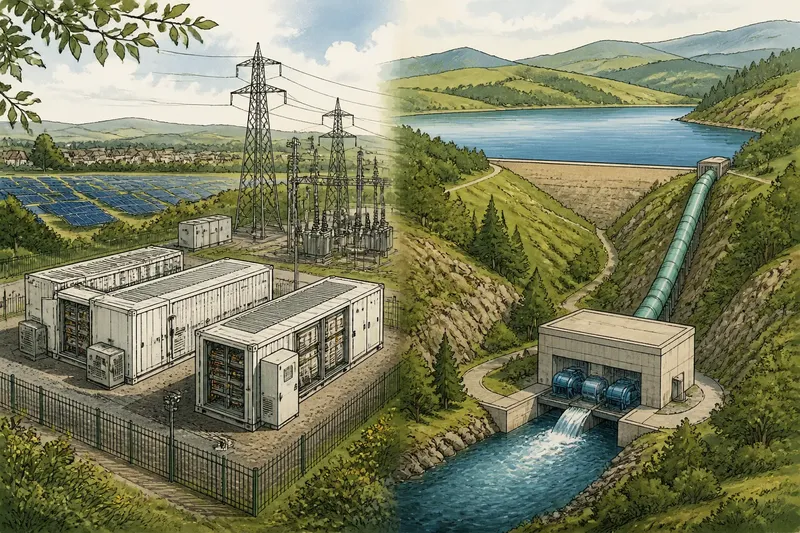
Batteries or pumped storage hold energy by changing electricity into something else, then converting it back when needed. A battery stores energy through chemical changes inside its cells; pumped storage lifts water to a higher reservoir. That difference shapes how each system is built, operated and connected to its surroundings.
Two storage principles
Electricity is difficult to keep sitting in a wire for later. To store it, a system converts electrical energy into another form that can remain available until a demand arises. The conversion works in reverse when the grid needs electricity again.
In a rechargeable battery, electricity drives chemical reactions that move charged particles within the cell. When the cell discharges, those reactions proceed in the opposite direction and electrical current flows out. The stored energy is chemical, even though the system takes in and supplies electricity.
Pumped storage uses gravity and moving water. When electricity is available to run pumps, water is moved from a lower reservoir to an upper one. Later, it flows downhill through turbines connected to generators. The stored energy is gravitational: water at a higher elevation can release energy as it descends.
Both systems therefore act as energy converters, not sources of energy. They can return some of the electricity used to charge or pump them, but the process has losses. The useful comparison is not which one creates energy, but what each must be able to do before it can store any.
Inside a battery
A battery system is made from electrochemical cells, grouped into modules and racks, with equipment to monitor and control them. An inverter converts between the direct current used within many battery systems and the alternating current commonly used by the grid. Cooling, fire protection and control systems also form part of the installation.
The chemistry matters. Lithium-ion batteries are widely used in grid storage, while other chemistries can be chosen for different operating needs. Their materials, operating limits and maintenance requirements vary, so “battery storage” describes a family of technologies rather than one uniform machine.
To charge, the system takes in electricity and stores it through chemical changes. To discharge, it reverses those changes and delivers electricity through power-conversion equipment. The system can respond to control signals without waiting for water to travel through a large pipe or turbine, though its actual response depends on its design and operating state.
A battery installation can be built at different scales, from equipment near a renewable generator to a larger facility connected to a substation. Its location still matters: connection capacity, land, cooling needs and safety planning all affect where it can sensibly operate. A compact footprint does not mean that siting and infrastructure are irrelevant.
Inside pumped storage
Pumped storage depends on a pair of reservoirs at different elevations, a way to move water between them, and machinery that can pump and generate. In some plants, reversible pump-turbines perform both jobs; other designs use separate equipment. The upper reservoir is the store, while the waterways and power equipment form the route in and out.
When pumping, the machinery uses electricity to raise water. When generating, water descends through a turbine and turns a generator. The amount of energy the plant can hold depends in broad terms on how much water is available and how far it can fall. This makes the landscape part of the storage mechanism, not merely a place to install the machinery.
Unlike a battery installation that can be placed near a suitable electrical connection, pumped storage requires a viable site with the right topography and water arrangements. Reservoirs, tunnels or pipes, powerhouses and grid connections call for substantial civil works. Existing reservoirs or suitable excavations may offer possibilities, but local environmental and water conditions still shape the project.
Once built, pumped storage can shift water between reservoirs repeatedly as operating needs change. It is a large physical system with moving parts, water-management duties and a fixed relationship to its site. Its scale can make it useful for storing and releasing substantial amounts of energy, but it cannot simply be moved to a new location when the grid changes.
What sets them apart
The clearest difference is the stored form: chemical energy in batteries, gravitational potential energy in elevated water. That distinction leads to different physical footprints and operating arrangements. Batteries rely on cells and electronics; pumped storage relies on reservoirs, waterways and turbines.
They also differ in how storage capacity is built. A battery plant’s energy capacity is tied to the cells installed, while its power-conversion equipment determines how quickly it can charge or discharge. In pumped storage, reservoir volume and the usable height difference shape the amount of energy held, while pumps and turbines influence the rate of movement and generation. These are related but distinct design choices in both systems.
Both experience losses when energy is stored and later released. For batteries, losses arise through electrochemical processes and power conversion. Pumped storage loses energy through pumping, water movement and generation. Neither returns every unit of electricity it takes in, and the exact balance depends on the particular design and operating conditions.
They differ in the work required to create them, too. Battery projects involve manufactured cells, power electronics and careful management of materials and heat. Pumped-storage projects involve major civil infrastructure and a suitable water-and-elevation arrangement. The relevant environmental questions are consequently different: material sourcing and end-of-life handling for batteries; land, water and habitat effects for reservoirs and waterways.
Choosing by task
Imagine a town with a solar farm beside an existing substation and a nearby valley that has no suitable reservoir sites. A battery could be considered close to the electrical connection, where it can absorb surplus electricity and release it later. The expected observable result would be electricity flowing into the battery when it charges and flowing back through its inverter when it discharges; this does not make it the right choice for every town or every duty.
Now imagine a region with a suitable elevation difference, established water infrastructure and a need to move energy across longer operating periods. Pumped storage might fit that setting because the reservoirs can hold water for later generation. The expected observable result would be water moving uphill during pumping and downhill through generating equipment during release. The site’s environmental effects, water arrangements and grid connection would still need careful consideration.
These situations are invented to show how the operating principle informs a decision. A battery is not automatically better because it is modular, and pumped storage is not automatically better because its reservoirs are large. The useful question is whether a technology’s physical requirements and operating characteristics match the grid service, site and timescale being considered.
Questions about storage?
Can batteries store electricity directly?
No. A rechargeable battery converts electricity into chemical energy during charging and converts that energy back into electricity during discharge. The stored energy is not electricity waiting unchanged inside the cells.
Does pumped storage need a river?
Not necessarily, but it needs an appropriate water arrangement, two reservoirs at different elevations and a way to move water between them. Whether a site can use existing water infrastructure depends on local conditions and project design.
Can both technologies provide power to the grid?
Yes. Batteries supply electricity through power-conversion equipment, while pumped-storage turbines drive generators as water descends. Their ability to meet a particular grid need depends on the equipment, site and operating conditions.
Which one is more efficient?
There is no single answer that applies to every battery chemistry and pumped-storage plant. Each loses energy during charging, storage and discharge, so comparisons need to specify the systems and operating conditions being considered.
What not to overcomplicate
It is not useful to treat “storage” as one interchangeable box on a grid diagram. Nor does a simple claim about batteries being quick or reservoirs being large settle the choice: the details lie in what is stored, how it is converted and what the site can support. There is little value in comparing headline capacity alone while ignoring the power equipment, connection and intended duty.
For batteries or pumped storage, start with the physical store: charged chemical materials or elevated water. Then ask what equipment releases that energy, what the site must provide and what kind of operation the system is meant to serve. That sequence makes the comparison concrete without turning either technology into a universal winner.