Before the National Grid: How Connected Power Networks Broadened Electricity Supply
Connected power networks let electricity move beyond a local station’s reach, linking separate supplies and changing how communities could receive power.
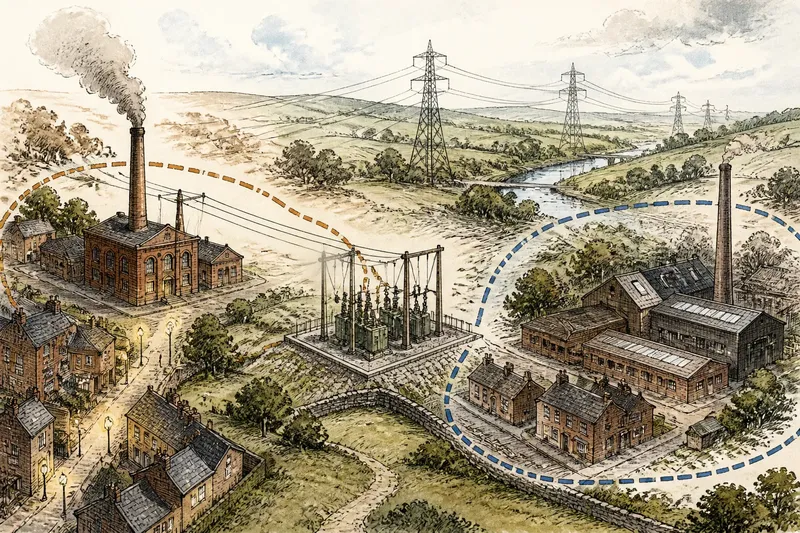
Before Britain had a coordinated high-voltage transmission network, electricity supply often depended on local systems with limited reach. Connected power networks changed that arrangement by creating routes between supplies that had previously served separate areas.
Local supply boundaries
In the early development of electricity, a generating station and the customers it served could form a compact system. Wires ran from a station to nearby streets, buildings or industrial premises; the precise arrangement varied by place and operator.
Those boundaries mattered. A customer outside a network’s reach could not draw electricity from a station simply because it existed nearby. Extending supply meant building suitable infrastructure, and a place with growing demand might need a new arrangement or more generation.
It is safer to describe this as one important pattern in early supply than as a universal model. Local systems differed in size, ownership and purpose, and their development followed local circumstances.
Separate systems
As electricity use spread, distinct systems served towns, industrial sites and other groups of customers. Some were operated by local authorities, some by private companies, and some were designed around a particular site. Their equipment and operating arrangements could differ, and their networks did not automatically connect.
On a map, supply could therefore appear as separate patches rather than one continuous web. A station might have spare output while another area needed supply, yet the electricity could not pass between them without a suitable connection and arrangements for operating it.
Each system had to manage its own generation and local network. This could mean duplicated infrastructure, but it also reflected the practical limits of building and running a supply for a particular set of customers. The important point is not that every local system worked alike; it is that physical and organisational boundaries could restrict exchange.
What did connection change?
What is an interconnected power network?
It is a set of electricity systems linked so that power can pass between them. A physical link makes exchange possible, while compatible equipment and operating arrangements determine how it can be used.
Did one connection create a national grid?
No. A link could connect particular systems without uniting their ownership or management. Wider coordination and transmission routes developed over time rather than appearing with a single connection.
Why do substations matter?
Substations help connect parts of the electricity system and manage the voltage used along different routes. They are among the pieces of infrastructure that allow power to move between transmission networks and local distribution systems.
Did distance stop mattering?
No. Transmission lines and other equipment still set practical limits on where electricity could flow and how much a route could carry. Interconnection widened the available paths; it did not remove the need for infrastructure.
From local links to wider routes
Once systems were connected, the area a generator could help serve no longer had to end at the boundary of its original local network. Electricity could move towards other connected districts, subject to the available routes and operating arrangements.
Imagine, as an invented example, a town whose local station serves nearby streets and a neighbouring industrial district with a separate supply. The starting point is two unconnected systems. Their operators arrange a suitable link, check that the equipment and operating rules allow exchange, and agree when the connection may be used. The resulting change is observable: electricity can now travel between the districts through that route, although its use still depends on the network’s capacity and operating conditions.
That distinction matters: connection creates an option, not an unlimited flow. Cables, substations and other equipment constrain the routes available, while operators must account for conditions across the linked systems.
Coordination and trade-offs
A cable alone does not make a shared network. Operators need communication and agreed procedures so that connected equipment works together. As connections extend, activity in one area can affect flows elsewhere, giving operators reasons to consider more than their own local station and wires.
Interconnected systems could remain separate in ownership or administration. Some exchanges took place across particular links without creating a single organisation or a fully unified way of working. The transition was gradual and varied, not a switch from isolation to complete coordination.
A broader network can make supply routes more flexible, but it also increases reliance on shared infrastructure. An issue on a significant link may affect more than one area, so the network depends on careful operation, maintenance and investment. There is little value in treating every early local supply as a miniature version of the later National Grid: the useful distinction is whether a system could exchange electricity with others, not whether it resembled a modern network.
Building a national system
Britain’s National Grid is associated with the later development of a coordinated high-voltage transmission system. Its emergence rested on more than drawing lines on a map: transmission routes, connections between systems and arrangements for coordinating their use all mattered.
Local distribution still has a distinct job. It carries electricity through local networks towards homes, businesses and other users. Transmission connects larger parts of the system and helps move electricity between regions. Generation may be distant from the user, while these different network layers link the source to the point of use.
Connected power networks changed electricity supply by making exchange across local boundaries possible. For anyone tracing how electricity reaches a place, the useful question is not only where it was generated, but which transmission and distribution routes connect that source to local supply.